
How to memorize a map in 3 steps
Always mixing up the same regions? A simple method for memorizing a map, with a quiz to test yourself right away.
Always mixing up the same regions?
Jumping straight into a quiz before you know the map doesn't work — you just rack up mistakes and lose motivation. The right method comes in three steps — get your bearings, learn by playing, then test yourself for real.
Step 1 — Get your bearings, no pressure
Open the map without starting the quiz. No timer, no score — just the outline. Count the territories, spot the big blocks, the coastlines, the borders. With the French regions, there are only thirteen: a single glance is enough to take in the whole picture.
Where territories are packed close together, zoom in to tell them apart visually. The goal at this stage isn't to memorize names — it's to build a mental map of shapes and positions.
Step 2 — Learn by playing
Start the quiz, but treat this first round as practice, not a test. For each question, the quiz gives you the name to find — "Click on Bourgogne-Franche-Comté" — and you look for the right area.
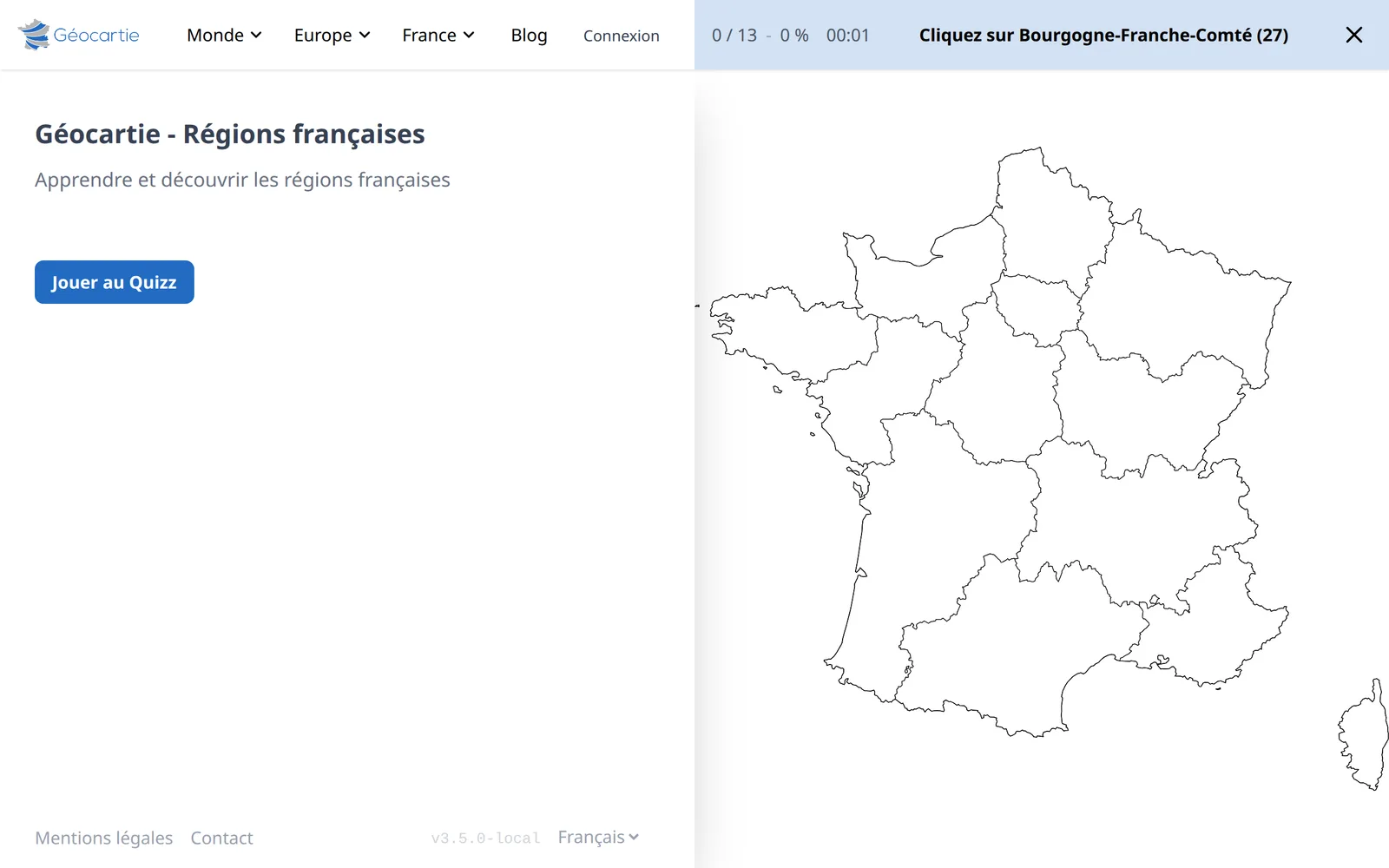
Get it wrong? No problem — quite the opposite. After a few tries, the correct area lights up and shows you where it's hiding. That's exactly how names stick — by pairing a name with a position, once, twice, ten times. During this round, don't look at your score: you're learning, not being graded.
Step 3 — Test yourself for real
Start the quiz again. This time, the score counts. You already know the shapes (step 1) and you've linked the names to their positions (step 2): this round finally feels satisfying instead of frustrating. Keep going until you get a perfect score.
👉 Start right now with the French regions: enough territories to make it a real challenge, few enough to complete the map in a single game.
Move on to the next map
The same method works for any map. Once you've mastered the regions, level up with the departments — the densest map of France — or head beyond France's borders with the countries of Europe.
🎯 Track your progress. With a free account, your scores are saved from one review session to the next: step 3 becomes an upward curve instead of a one-off number.